Figure 4
Functional block diagram of the command subsystem.
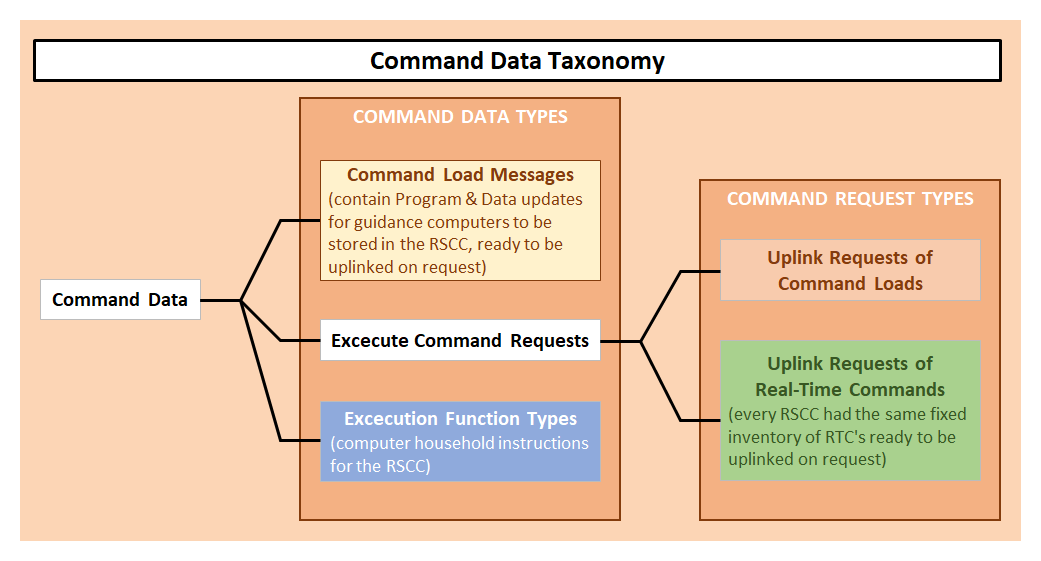
In this diagram is indicated which controllers had command panels on their consoles to initiate uplinks of command loads or real-time commands (RTCs) to the spacecraft:
- MOCR controllers: BOOSTER, GUIDO, CONTROL and INCO
- CCATS controllers: Command Load Controller and Computer Command Controller
- CCATS controllers in a supporting role: Real-Time Controller and Telemetry Instrumentation Controller
Their role was related to the formatting and routing of the command data messages.
- RTCC controllers: RTCC Network & Command Process Controller ?
Personal reminder 1
The grey blocks refer to the supposed option to conduct end-user tests if command loads will have an impact on the way astronauts have to interact with AGC or LGC. I need to check on that. The command panels I am referring to seem to be unnecessary for requesting to uplink command loads or RTCs. And conducting end-user tests to check on the usability when a command load affects the interaction between the crew and guidance looks essential to me. And since the flight controller was responsible for final acceptance of a created command load, it would make sense to me that this officer had the means to perform the tests.
Personal reminder 2
I need to check whether and how the RTCC Network & Command Process Controller could initiate uplinks. The primary responsibility was to generate command loads on request of a MOCR controller. The console of this RTCC controller was equipped with panels, which seems to suggest that uplinks could be initiated.
|
Figure 5
Voice loop for requesting the generation of command loads
In this diagram is shown which MOCR controllers were involved in generating command loads and which controllers were required to request uplinks of command loads and RTCs.
Load generation requests
According to ref.11 on page 9-6 the controllers BOOSTER, FIDO, GUIDO and RETRO were required to request the generation of command loads. According to the voice loop configuration as depicted above, the voice loops "RTCC DYN", "REENTRY SUPPORT" and "RTCC CMD NET" were used by these four MOCR controllers to request a so-called command load generation. These three voice loops were monitored by the RTCC Computer Command Controller, who was responsible for generating the command loads.
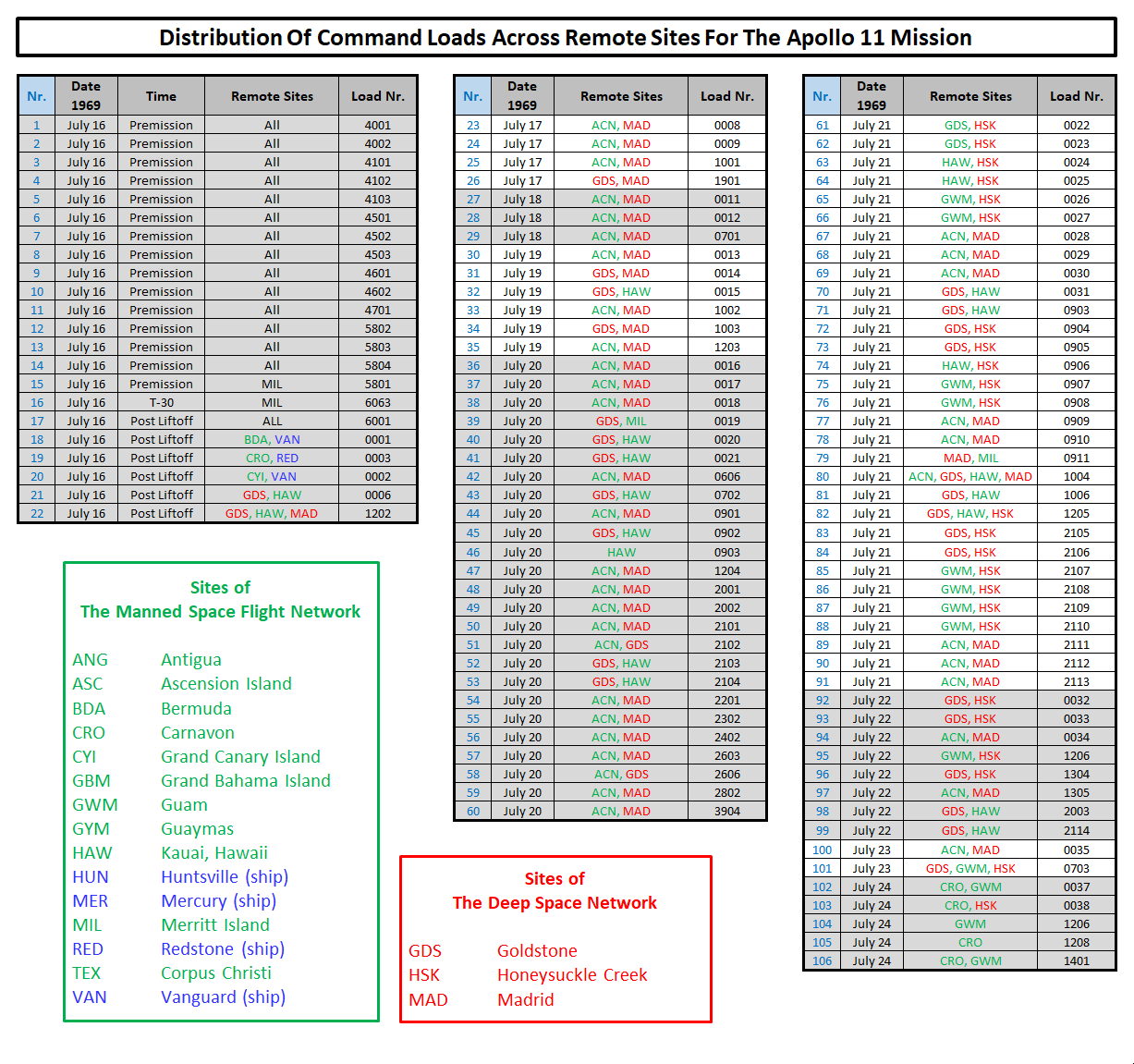
When they have gone through the generation process, the command loads were transferred to various remote sites, if not to all, on request of the MOCR controller.
Uplink requests
The consoles of the controllers INCO, CONTROL, BOOSTER and GUIDO were equipped with command panels to send requests via CCATS to a remote site to uplink a command load or an RTC to the spacecraft.
It is remarkable, however, that the controllers FIDO and RETRO were required to request a command load generation but that their consoles were not equipped with command panels to request an uplink.
Note 1
I assume that FIDO and RETRO had several options to have an uplink requested:
- Asking their colleague controllers GUIDO and BOOSTER to request an uplink using their command panels.
- Based on ref.2 figure 1, the CCATS Command Controller (CCC) could dispatch an uplink request on behalf of a MOCR Controller.
- Asking the RTCC Computer Command Controller to request an uplink. I assume the RTCC CCC was using the teletype to issue the request via CCATS. I also assume that the RTCC CCC could use voice loop "RTCC CMD NET" to pass the request on to the CCC.
Note 2
The EECOM links of the voice loops have been derived from ref.13 in which a detailed rendering is shown of the keyset unit of the EECOM console. A keyset unit enabled a MOCR controller to monitor voice loops and participate in the conferences on those loops. The EECOM voice loop links as shown in the drawing are based on the key inscriptions of the keyset unit. It would make sense to me that the other system engineers, GNC, TELMU and CONTROL, which had similar responsibilities as EECOM, would have access to the same voice loops. So I have drawn the links as dotted lines to denote that these links are assumed.
Note 3
The consoles of the system engineers / MOCR controllers EECOM, GNC, and TELMU were not equipped with command panels to request uploads of command loads or real-time commands (RTCs). The console of their colleague system engineer CONTROL was, however, equipped with command panels. Since it seems obvious to me that the system engineers needed to control spacecraft systems remotely, I assume they requested uploads of RTCs via CONTROL.
Note 4
Another option for requesting uplinks would have been asking support from the CCATS controllers. I assume that the system engineers were using voice loop "RTC" to issue an upload request. The name "RTC" refers to the fact that the CCATS Real-Time Controller (RTC) was central in this voice loop. The RTC established the command data channel by selecting the console of the applicant and the remote station from which the RTC must be uplinked. I therefore assume that the voice loop "RTC" was monitored by the CCC to be able to act promptly and request an uplink on behalf of the MOCR system engineer. I also assume that this voice loop was monitored by the CCATS Command Load Controller and the RTCC CCC.
|