Saturn V - Apollo
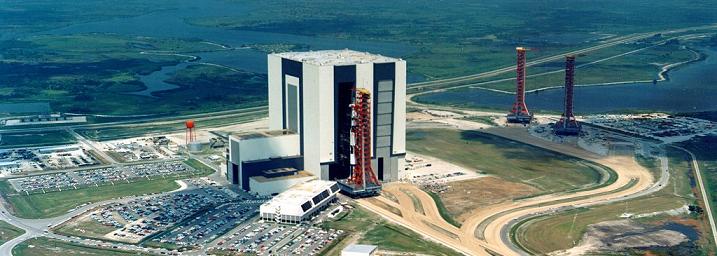
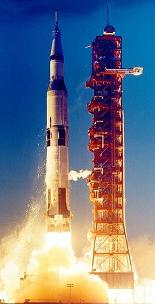
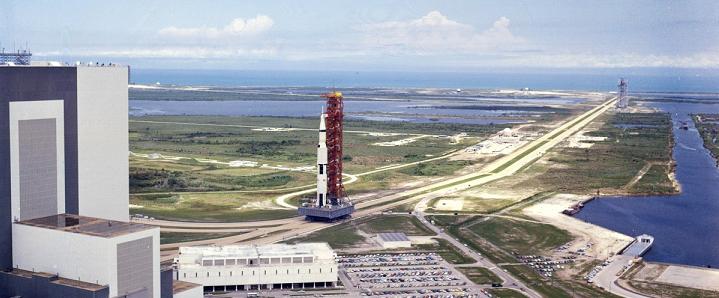
The Saturn V is a three-stage launch vehicle. Thirteen of these rockets had been launched with a success rate of 100%. All vehicle configurations, except for the last one (SA-513), were more or less identical: a Saturn V launch vehicle with an Apollo spacecraft on top. The whole stack stood 111 meters tall.
The launch weight of a Saturn V – Apollo came to 2900 Tons.
Without fuel, its weight was 230 Tons.
The five first stage F-1 engines delivered a total thrust of about 3700 Tons.
The total weight of the Apollo spacecraft (orbiter + moon lander) came to 45 Tons.
Apollo 4: maiden flight for all stages, all at once
The first flight qualification test, known as the Apollo 4 mission, had been conducted on vehicle SA-501 on 9 November 1967. Despite the fact that the three stages had never flown before, results of static qualification tests on each stage had made NASA confident about the success of an all-up test in which all components would be flight tested for the first time at once. At that time the whole Apollo program had suffered a lot of delays, which had made the launch schedule very tight if NASA wanted to have a moon landing before 1970. The flight of the SA-501 was, in that sense, of paramount importance. This flight was meant to prove that America could fly to the moon with this rocket. It was a tremendous great relief that the mission was very successful; all the mission objectives were met. It gave NASA confidence, not only in the design of the Saturn V, but also in the whole process from construction, testing, and launch preparation up to mission management.
Apollo 6: the second unmanned all-up flight
The flight of the also unmanned SA-502 (Apollo 6) was less successful. The Saturn V suffered from heavy longitudinal vibrations during the first minutes of the flight. And two of the five second-stage J-2 engines failed in mid-flight. During the boost phase, the launch vehicle was able to compensate for the second-stage engine failures by adjusting the burn times of the three remaining second-stage engines and the single J-2 engine of the third stage. The desired parking orbit could be obtained. But unfortunately another malfunction showed up: the third-stage engine failed to restart. Because of that, the orbit could not be altered. This capability of a J-2 restart was essential for a translunar flight and was one of the most important mission objectives. Without a restart it was not possible to inject a spacecraft from a parking orbit into a translunar trajectory. Thanks to the sophisticated telemetry in which hundreds of parameters could be monitored remotely, all these problems could be analyzed and became well understood. Solutions could be implemented with relative ease. So the Apollo 6 mission didn't raise any doubts or second thoughts about the design and the construction of the Saturn V.
The Space Race
The Apollo Program was America's answer in the Cold War-related space race between the USA and the Soviet Union. Winning this race would show the ability of a country to mobilize all endeavour necessary to achieve technological superiority. Such an achievement would reflect on its global political and military power, which leans heavily on technology. The Soviet Union had already achieved a couple of firsts: first man in space, first woman in space, first spacewalk, and first rendezvous in space between two spacecrafts. There were two firsts left: the first manned circumlunar flight and the first manned moon landing. A first moon landing would undoubtedly be of great historical importance and would have a huge impact on national prestige.
Apollo 8: a bold mission
In autumn 1968 intelligence reports gave reasons to suspect that the Soviet Union was about to make a manned circumlunar flight with its brand-new N-1 superbooster, which had a payload capacity comparable with that of a Saturn V. It has pushed NASA to make the bold decision to declare the Saturn V launch vehicle and the Apollo Command & Service Modules qualified for manned circumlunar flights. Nevertheless, the Saturn V had only flown twice. Almost prematurely, the third Saturn V (SA-503) was selected for the first manned circumlunar flight in December 1968, mission name "Apollo 8". Although the Apollo 6 mission didn't go without flaws, the mission experiences with the recent Saturn V flights had given NASA enough confidence that the risks involved were manageable.
The Apollo spacecraft also imposed a considerable risk; it had only been used once in a manned mission, on an orbital flight around Earth (Apollo 7). Therefore, it was decided to meticulously monitor the condition of this not yet fully matured Apollo spacecraft during the Apollo 8 mission, to be able to take immediate appropriate action if necessary.
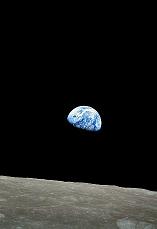
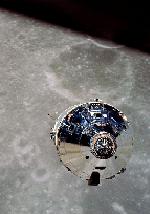
This breathtaking mission was very successful. For the first time humans were orbiting the Moon and could see her far side with their own eyes. At the far side, radio contact was lost with Mission Control for about half an hour on each pass. The first pass at the far side were tense moments.
For reasons of safety, the translunar trajectory was a so-called free return trajectory, in which the spacecraft automatically would return to Earth after one pass around the moon if no trajectory corrections were to be made. Therefore, a rather critical burn with the large Service Propulsion engine was needed to slow the spacecraft down to bring it into a parking orbit around the Moon. This manoeuvre, however, had to be made at the far side of the Moon, during which no contact with Earth was possible. So after the burn, the crew of Apollo 8 and Mission Control had to wait about 20 minutes before Apollo 8 reappeared from behind the Moon and contact with Mission Control could be re-established for also 20 minutes. Only during that period of contact could the obtained flight path be determined with the desired accuracy by using radar techniques from Earth-based radar stations. If the obtained flight path would deviate too much from the required one, additional orbital manoeuvres had to be made, or worse: Apollo 8 could have been on a collision course with the Moon. The burn, however, was successful, and the spacecraft had obtained just the right orbit as had been calculated by Mission Control. A major milestone had been achieved, and it gave NASA much confidence in the way flight trajectory was managed. Ten orbits were made with the Apollo 8 spacecraft. After these ten orbits, a similar delicate manoeuvre was needed to leave the parking orbit around the Moon and bring the three men back to Earth. This burn was also a critical and tense moment in the mission; if the engine failed, there were no options left to bring the men back to Earth safely. The engine had to ignite. The service propulsion engine appeared to operate flawlessly during the whole mission, and the Apollo command module, with the three astronauts inside, made a water landing in the Atlantic Ocean on 27. This 4 meter-high conical-shaped module was the only piece of hardware which remained from the 112 meter-high, 2800 metric Tons heavy, Saturn V - Apollo stack. December 1968 after a 6-day mission. Both the Saturn V and the Apollo spacecraft had performed flawlessly; it gave NASA a lot of confidence to push forward and to execute the plans for a manned moon landing.
Apollo 9: qualifying the rendezvous technique
The fourth (SA-504) Saturn V has been used to bring the CSM and the lunar module into space for the first time. The primary objective of this mission was to vindicate the rendezvous technique in which two spacecrafts could be physically linked up by their pilots anywhere in space. This technique was of paramount importance for a successful moon landing.
Apollo 10: the dress rehearsal for the moon landing mission
The fifth Saturn V (SA-505) has been used for the final moon landing qualification test. All procedures and flight manoeuvres were tested, up to final descent.
Apollo 11: the moon landing mission
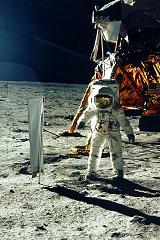
The sixth Saturn V (SA-506) has been used for the first moon landing mission (landing on 20 July 1969).
Both the CSM and the LM had proven to be fit for this mission. All parts of this mission had been done in previous missions except for the final descent and the lift-off sequence from the lunar surface. There were contingency plans and mission rules to minimize risk. But the landing was a totally new flight experience, and this phase of the mission was certainly not without risk. The landing had to be done manually to avoid, for instance, boulders in the landing zone. And there was a risk that during the landing the craft could still crash or topple over.
If you are interested in my personal view on the Apollo moonlanding missions: Contemplation
Apollo 12: the accurate moonlanding
[Comment to be added]
Apollo 13: the succesful failure
[Comment to be added]
Apollo 14: back on track
[Comment to be added]
Apollo 15: Science on the Moon
[Comment to be added]
Apollo 16: More science on the Moon
[Comment to be added]
Apollo 17: the last moonlanding
[Comment to be added]